
By Andrew Yoder, Power Platform Solution Architect
Introduction
Microsoft’s $80 billion investment in AI and Copilot technologies for 2025 isn’t just a headline. It’s a clear signal that the future of work is being redefined. It is a staggering commitment for a single fiscal year, and we can only imagine what additional spend is planned for 2026.
Why does this matter? Because Microsoft’s entire business is helping organizations accomplish more through business applications. They study this space relentlessly, and their conclusion was that $80 billion needs to be spent to move in this direction. If there is one company synonymous with conducting business using technology, it is Microsoft. They are the preeminent authority on how business gets done on computers, over the internet, and in the cloud. This is their assessment of where the future lies, and it demands attention.
Your organization needs to be ready for this shift. It is not as simple as plugging in new tools and getting to work. Copilot Studio and the new way of building AI-driven processes come with prerequisites. You need to be cloud-capable. Your data must live in the cloud, your applications must be connected, and your ecosystem must be clean and well-maintained. If you are still tied to legacy technologies, you will not be able to leverage these tools. Meanwhile, competitors who have made the jump will gain a significant advantage.
The gap between cloud-ready companies and those still lingering on outdated systems will widen dramatically. Businesses that have prepared will be able to grow without adding headcount, reduce costs, and introduce new services simply by configuring new agents. Those who haven’t will struggle to keep pace. This is not just a technology upgrade—it is a strategic moat that will define competitive landscapes for years to come.
At the Community Summit 2025, one message was clear: the next era of business automation will be powered by AI reasoning, natural language instructions, and agentic capabilities, all orchestrated within Copilot Studio. This isn’t incremental change. It’s a paradigm shift. And for businesses, the question isn’t if this transformation will happen—it’s how soon you will adapt.
The Big Shift in Business Process Design
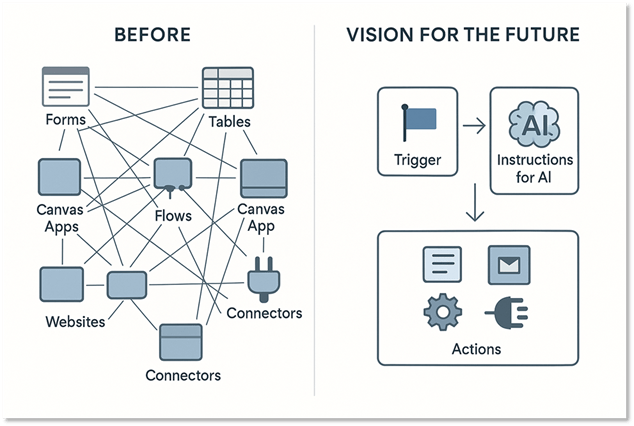
For years, solving a business problem meant building systems that humans could navigate—forms to fill out, workflows to follow, and automations to trigger. These systems lived in the cloud as distinct puzzle pieces, requiring developers and consultants to fit them together with code and configuration.
Copilot Studio flips that model on its head.
Instead of coding logic into rigid workflows, businesses will define three simple elements:
- Triggering Events: An email arrives, a database field updates, a customer submits a form.
- Plain Language Instructions: Think of it as an instruction manual for a new hire—clear, human-readable steps that explain what to do when the trigger occurs.
- AI-Driven Actions: Update a record, generate documentation, draft and send an email, or even orchestrate a multi-step process across systems.
The AI doesn’t just execute tasks—it reasons over the instructions and the context of the trigger to decide the best course of action. What used to require human interpretation and manual effort now happens instantly, without breaking the flow of work.
This shift means consulting isn’t about writing code for every edge case anymore. It’s about designing triggers, crafting business logic in natural language, and connecting the right tools so AI can act intelligently. In short, we’re moving from building systems for humans to building systems that think like humans.
The Rise of Agents
One of the most exciting concepts coming out of Community Summit 2025 is the idea of “agents.” Think of an agent as a digital specialist, a virtual team member that owns a specific business process. You might have a Sales Agent that manages lead qualification or a Customer Service Agent that handles case resolution. These aren’t just automations. They are intelligent, reasoning entities that can interpret instructions, make decisions, and take action without waiting for human intervention.
Why is this such a big deal? Historically, automation hit a wall whenever a process required judgment or layered logic. At that point, the system would pause and hand off to a person. Copilot Studio changes that dynamic. By combining natural language instructions with AI reasoning, these agents can handle those decision points themselves. They can read the context, apply the rules, and move the process forward.
This is where orchestration and integration shine. Agents aren’t isolated bots. They are connected to your data, your applications, and your workflows. They can update records, generate documents, send communications, and even trigger other processes across systems. In short, they don’t just automate tasks; they orchestrate outcomes.
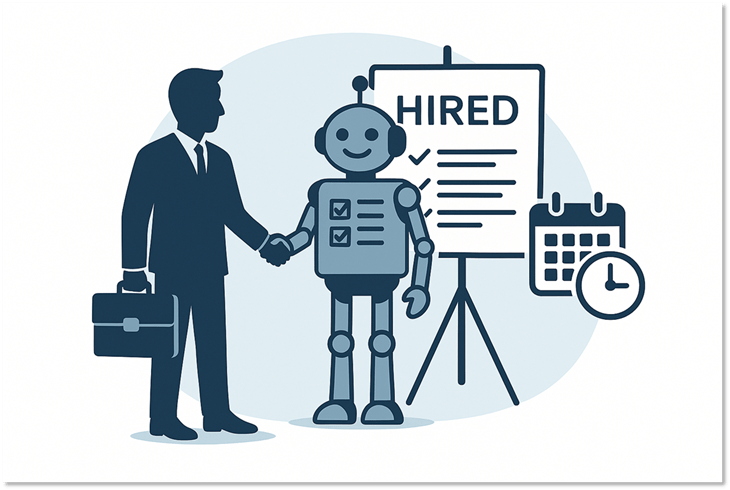
For businesses, this means fewer bottlenecks, faster cycle times, and the ability to scale without adding headcount. It’s not hard to imagine a future where configuring a new agent becomes as routine as hiring a new employee, except the agent never takes a vacation and can handle thousands of tasks simultaneously.
Practical Reality Check
It’s easy to get swept up in the excitement of AI and Copilot Studio, but here’s the truth: not every process needs an agent, and not every organization is ready to deploy them. The real value consultants can bring isn’t just implementing the latest technology, it’s knowing where it fits and where it doesn’t.
Some processes are still best served by traditional tools like Power Automate flows. If your workflow is a simple A-to-B handoff with no reasoning or layered logic, a flow might be faster, cheaper, and easier to maintain. Copilot Studio shines when a process requires interpretation, evaluation, or multiple decision points—the places where automation historically stalled and handed off to a human.
There’s also the matter of readiness. Copilot Studio assumes your business is cloud-capable. Your data needs to be accessible, your applications integrated, and your environment clean and well-structured. If you’re still tied to legacy systems or fragmented databases, jumping straight into AI-driven orchestration will be challenging. Meanwhile, competitors who have made the move to the cloud will be able to scale faster, reduce costs, and innovate without adding headcount.
The takeaway? AI isn’t a magic wand. It’s a powerful tool in the right context. Success will come from pairing vision with pragmatism, knowing when to deploy agents and when to stick with proven solutions.
Why This Matters and What Comes Next
Digital transformation is no longer a future goal, it is a present necessity. Businesses face mounting pressure to scale efficiently, innovate rapidly, and maintain resilience in an increasingly competitive and regulated environment. Success depends on adopting platforms and strategies that simplify complexity, enhance data visibility, and enable informed decision-making. AI-driven tools and low-code solutions are central to this shift, offering speed and flexibility without sacrificing governance or security.
The Evolving Role of Consultants
Consultants will remain essential in enabling organizations to succeed in an AI-driven, cloud-first world. Their value will center on five core areas:
1. Preparing Clients for Cloud Capability
- Organize and curate the client’s digital estate.
- Clean and structure data so it’s indexed, discoverable, and secure.
- Ensure AI agents can access only the right information—avoiding overload or inaccurate outcomes.
2. Designing and Building AI Agents
- Document processes, design logic, and draft agent workflows within Copilot.
- Apply soft skills for interviews and requirement gathering.
- Test, refine, and optimize agents to deliver reliable results.
3. Advising on Tool Selection
- Help clients decide when AI is appropriate and when traditional tools are better.
- Avoid “AI for everything” by recommending elegant, cost-effective solutions.
4. Integrating Systems
- Connect disparate systems so AI can synthesize data and trigger actions across environments.
- Ensure interoperability and security in multi-platform ecosystems.
5. Continuous Improvement
- Monitor, iterate, and enhance processes over time.
- Adapt solutions as business needs evolve and technology advances.
What’s Next?
The call to action is clear: move from planning to execution. Begin by assessing current processes, identifying automation opportunities, and establishing governance frameworks. Invest in platforms that enable scalability and empower teams with the tools and training needed to thrive in a digital-first world. Acting now positions your organization for sustainable growth and a competitive edge in the marketplace.


Leave a Reply